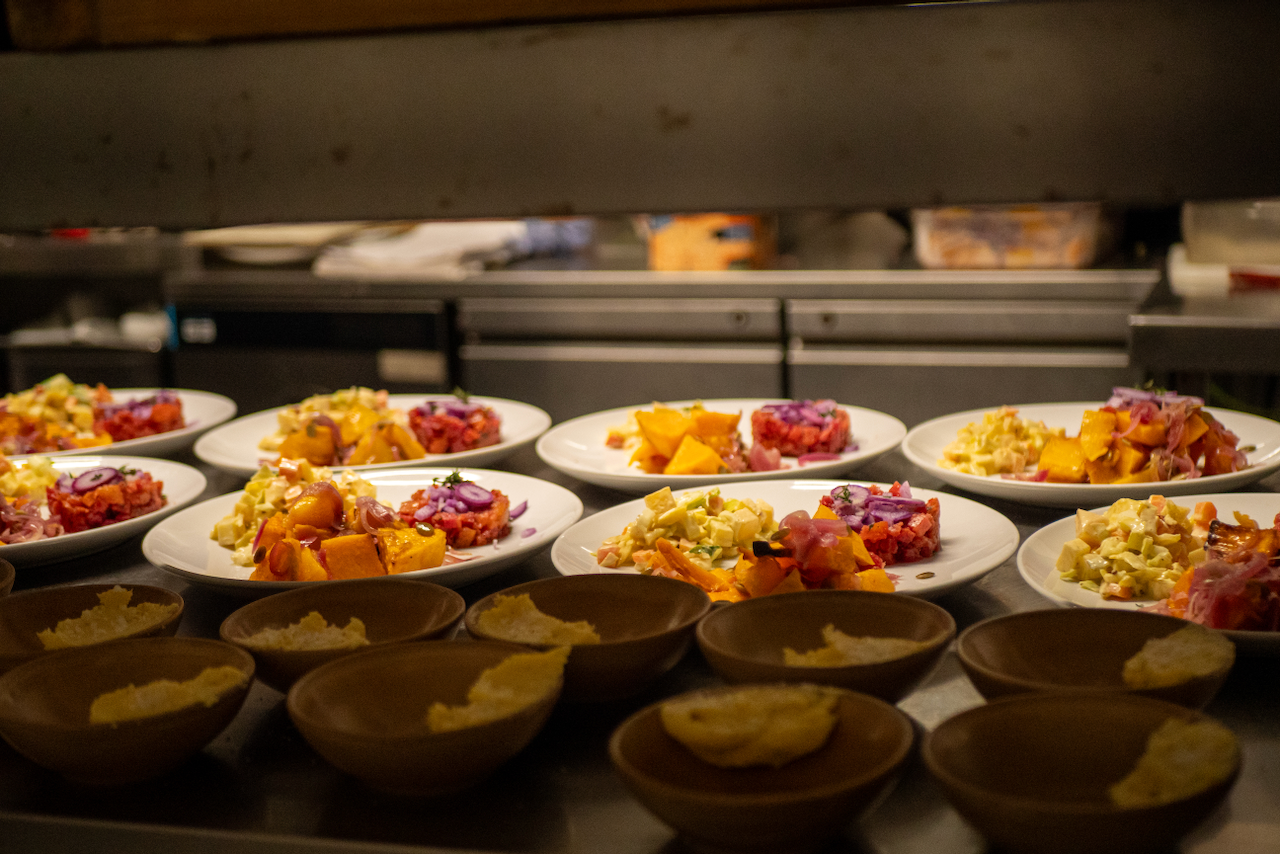
The building is ours, the kitchen’s ready, the name still means something.
The only losing move is leaving it empty. Here’s what we could do instead.
Where things stand
The Warren owns its building on Mansel Street outright — a fully equipped kitchen, a bar, a restaurant fit-out,
and a multi-award-winning reputation built over years. Right now it sits on hiatus, costing roughly
£1,000 a month just to hold empty.
The old model — a full restaurant, open nightly — worked for a long time, but struggled to break even as
staff costs climbed. The asset is excellent. The model was the weak point.
So the plan is built around three things: keep it
low-stress and simple, work to a
modest fit-out budget, and run it with a
business partner rather than alone. That steers us away from
the nightly grind and toward leaner ways of using the same great space.
The kitchen that’s already paid for. This is the bit no one has to rebuild.
The numbers · yours to correct
What we actually know
Every option above rests on these four numbers, and right now two of them are guesses and two are blank.
Fill in what you know and the whole thing gets sharper. Anything you leave alone stays as it is.
Our working number. Right, or nowhere near?
Original purchase price.
Most recent figure we have.
Roughly is fine.
Who this actually belongs to
Deri
Owner
Runs it, decides it, lives with it.
Celia & Mike
Parents · investors
£100,000 invested in the business.
Worth saying plainly: £100,000 of this is Mum and Dad’s. That doesn’t decide anything on its own,
but it does mean “leave it empty” costs them too, and any option that changes who owns what needs
their yes — not just ours.
The options · like a specials board
On the board
01
Café + Events
The lead option
A simple, low-overhead café by day. The real money comes evenings and weekends by selling the space for private functions — celebrations, wakes, small weddings, supper clubs. The kitchen fires up when there is booked, guaranteed revenue behind it, not on spec every night.
✦Far lower stress than a nightly restaurant — income booked in advance, not gambled on footfall.
✦Leans directly on The Warren’s reputation; a trusted name is exactly what sells a function room.
✦Modest fit-out — the kitchen and bar are already there.
✦Suits a two-person team: one front-of-house by day, both flexing up for events.
✦Qualifies for the council money below as-is — food and drink is an eligible sector and reopening safeguards jobs. No structural change needed.
Watch out — Café margins alone are thin — the events side has to do the heavy lifting on the running costs.
Your call
02
Cowork + Café Hybrid
Promising, but test first
Turn the restaurant floor into a flexible daytime workspace — desks, strong wifi, good coffee, a bookable meeting room. Members pay monthly or by the day; the room is hired by the hour; the café serves everyone.
✦Low staffing — could run with one or two people, no full kitchen brigade.
✦Recurring monthly membership is more predictable than nightly covers.
✦The building is already there; spend is on desks, wifi and coffee.
Watch out — Untested demand. Cowork lives or dies on whether 30–50 people within a drive will pay monthly for a desk. Best run as a daytime layer on top of Option 01, not the whole bet.
Your call
03
Lease It Out
The clean fallback
You own the building and the equipment. Someone else runs a café or restaurant as a tenant and pays you rent. The monthly loss stops immediately, the asset starts earning, and none of the staffing headache lands on you.
✦By far the lowest-stress option — removes the day-to-day entirely.
✦Stops the running-cost bleed the fastest, and flips it to income.
✦Near-zero spend; the tenant fits out to their own plan.
✦Keeps the asset and its long-term value in the family.
Watch out — You give up the upside, and a reliable tenant in a rural-ish spot is not always easy to find. Build standards into the lease to protect the name.
Your call
04
Community Business
Already the direction
Keep ownership, but bring the community in — as members, users, volunteers, part-funders of a fit-out — running the place partly for community benefit. Café and social hub by day, function space by night.
✦Unlocks the Welsh Government’s Community Facilities Programme — up to £300k of capital, rolling, no deadline. Nothing else on this page comes close to that number.
✦Free structuring help from Plunkett UK, and from Cwmpas for a community share offer.
✦A built-in customer base who feel ownership and actually turn up.
✦Strong survival record for community-run venues.
Watch out — The £300k has a price: that grant is only open to a constituted community body, so it means changing who owns The Warren — with £100k of Mum and Dad’s money already in it. That’s a family conversation, not a funding decision. Worth knowing too: the site already tells the public the future is “sustainable, shared, and community-led”, so this is less a new idea than a formal version of what’s been said out loud.
Your call
Side by side
Option 04 sits off this grid on purpose — it’s a route to explore by phone, not a costed model yet.
01 · Café + Events
02 · Cowork
03 · Lease
Stress level
Medium
Medium–High
Very low
Upfront spend
Low–Modest
Modest
Near zero
Who runs it
Deri + partner
Deri + partner
A tenant
Stops the monthly loss
Once trading
Once trading
Immediately
Income ceiling
Medium–High
Medium
Fixed (rent)
Uses the reputation
Fully
Partly
Tenant-dependent
Demand risk
Low–Medium
High (untested)
Low
The money · triage this
What's actually out there
You've raised money before, so you'll have been round some of these blocks already. That's exactly
what I need to know — mark the ones you've tried so I stop suggesting them, and flag anything
worth a call.
The thing that surprised me: the easiest money here doesn't need us to become a community business
at all. It's sitting with the council, it's aimed at food and drink, and the test is jobs.
The community route unlocks bigger money, but it costs you the ownership structure to get it.
Checked 15 July 2026. Grant schemes change constantly — treat every figure here as a starting point
for a phone call, not a fact.
Carmarthenshire Business Growth Grant
Best fit
Carmarthenshire County Council · UK Shared Prosperity Fund
How much
Capital + some revenue
What it costs us
Nothing — ordinary business
Eligible sectors explicitly include Food & Drink, Tourism and Retail. Open to businesses of any size. The test is that the spend creates or safeguards jobs, which reopening does. This is the most straightforward money on the list.
Catch — Their own eligibility page still shows 2025 dates while newer material says 11 May – 31 Oct 2026. The page contradicts itself, so ring them rather than trust either.
Aimed squarely at bringing empty ground-floor commercial units back into use in Carmarthen, Ammanford and Llanelli. A shut restaurant on Mansel Street is close to the exact thing this exists for.
Catch — Whether “on hiatus” counts as vacant is a question for them, not for us.
Interest-free loans to property owners bringing underused town-centre premises back into use. Not a grant — it comes back — but interest-free money against a building you own outright is close to free fit-out.
Catch — It is debt. Modest fit-out budget was the brief, and this still has to be repaid.
Small money for shopfronts: external decoration, painting, lighting, gutters. Not transformative, but it is the cheapest possible way to make the place look open again.
Catch — Small enough that the paperwork might cost more than the grant.
The big one. A rolling capital grant with no deadline, for buying or physically improving community facilities. Up to £300k, max three grants in three years.
Catch — Applications must be community-led from a constituted body — CIC, charity or social enterprise. The Warren as it stands cannot apply. This is the actual price of Option 04, and it is not a small one given whose money is already in the business.
Free business advice for community-owned businesses in Wales, available in Welsh. They work with around 100 community businesses in Wales already and treat rural Wales as an area they want to grow in.
Catch — Worth being clear: their grant funding programme is for Scottish community pubs. In Wales they give you a person, not a cheque. Still a free phone call.
Free help structuring and running a community share offer — legal structure, business plan, share offer document, promotion. If Option 04 wins, this is how you actually raise the money from people who already love the place.
Catch — You crowdfunded The Warren once already. You know what this costs in energy.
One to watch rather than chase: the First Minister announced on 13 July that Wales will develop its own
Community Right to Buy. It's a legislative intention, not law, and it gives communities first refusal
when an owner sells — so it does nothing for us while we own the building and aren't selling.
The old UK Community Ownership Fund is closed for good, and its English replacement doesn't reach Wales.
The honest steer
Given low-stress, a modest budget and a partner to share it with, the strongest fit is
Café + Events — with a light cowork layer added
only if a quick demand check stacks up.
It uses the kitchen and the reputation fully, keeps income booked-in-advance rather than gambled nightly,
and needs only modest spend. If the partner doesn’t come through, leasing
is the clean fallback that stops the loss straight away.
On the money: I had this backwards until I actually checked. The
community route isn’t the one with the accessible funding —
it’s the one with the biggest funding and the highest price, because £300k of Welsh Government capital
means restructuring who owns the place. The money you can reach without changing anything is
sitting at the council, aimed at food and drink, in the town you’re already in.
The one certainty: sitting empty is the only option guaranteed to keep losing £1,000 a month.
Anything active beats that.
Over to you
Tell me I'm wrong
Everything you've typed is saved in this browser as you go, so you can close the tab and come back to it.
Nothing reaches me until you press send.